

FlatFeed Product case study

01Problem

Berlin Wohnberechtigungsschein: a certificate used to qualify for subsidized housing in Berlin. apartment seekers repeat the same search across multiple websites.

Saved-search alerts on real-estate portals only cover listings published on their own platforms. Meanwhile, housing providers are a primary source of WBS listings and may publish them on their own websites before they reach real-estate portals. Some providers offer only email alerts; others offer none. Users therefore repeat the same search across several places and compare different listing formats. FlatFeed tests a simpler flow: save your criteria once and review matching listings in Telegram.

02Product

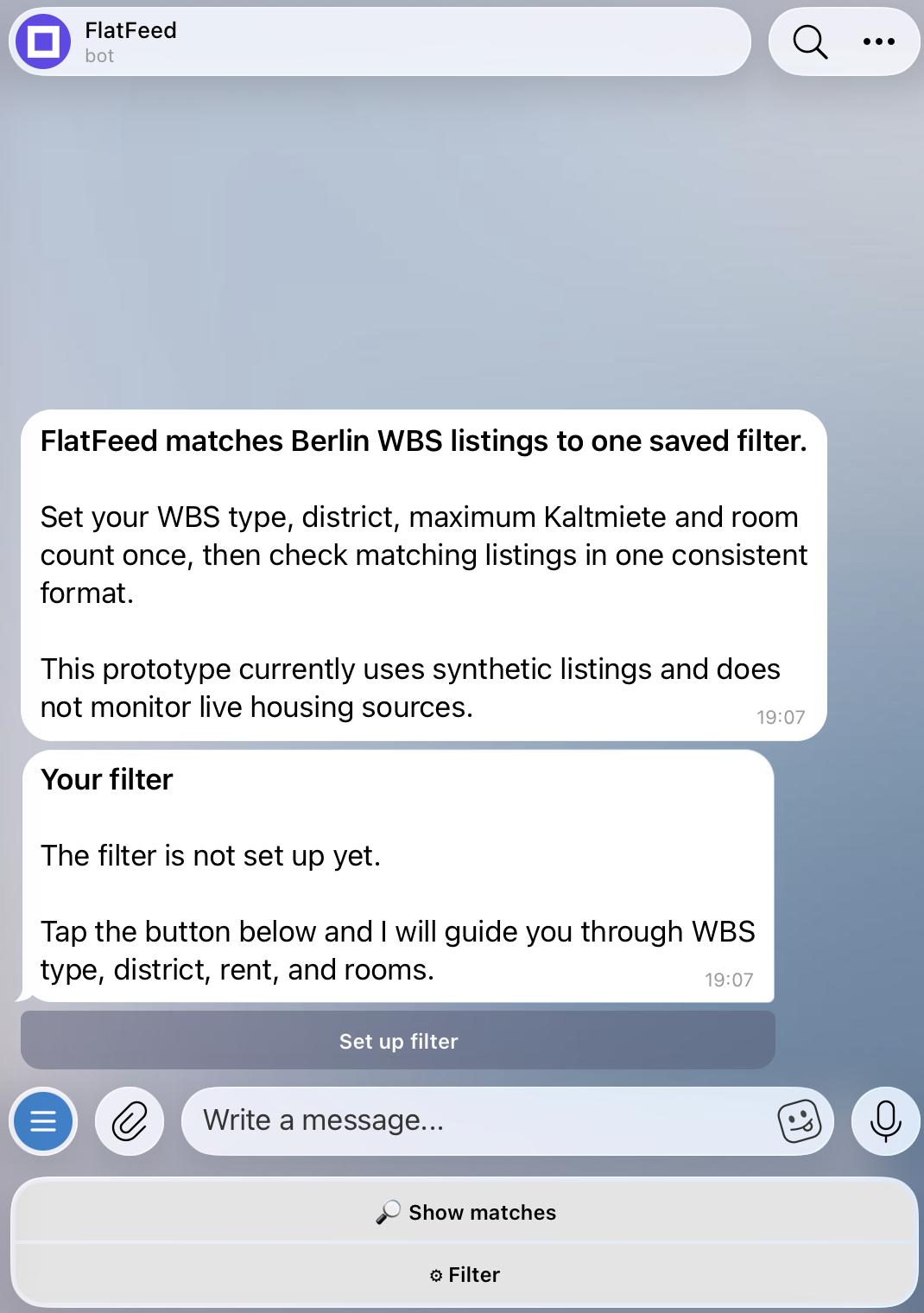
FlatFeed brings the fragmented WBS search together in one place.

Working Telegram prototype · Generated test listings · Rule-based matching · Bounded AI QA evaluation

  1. 01

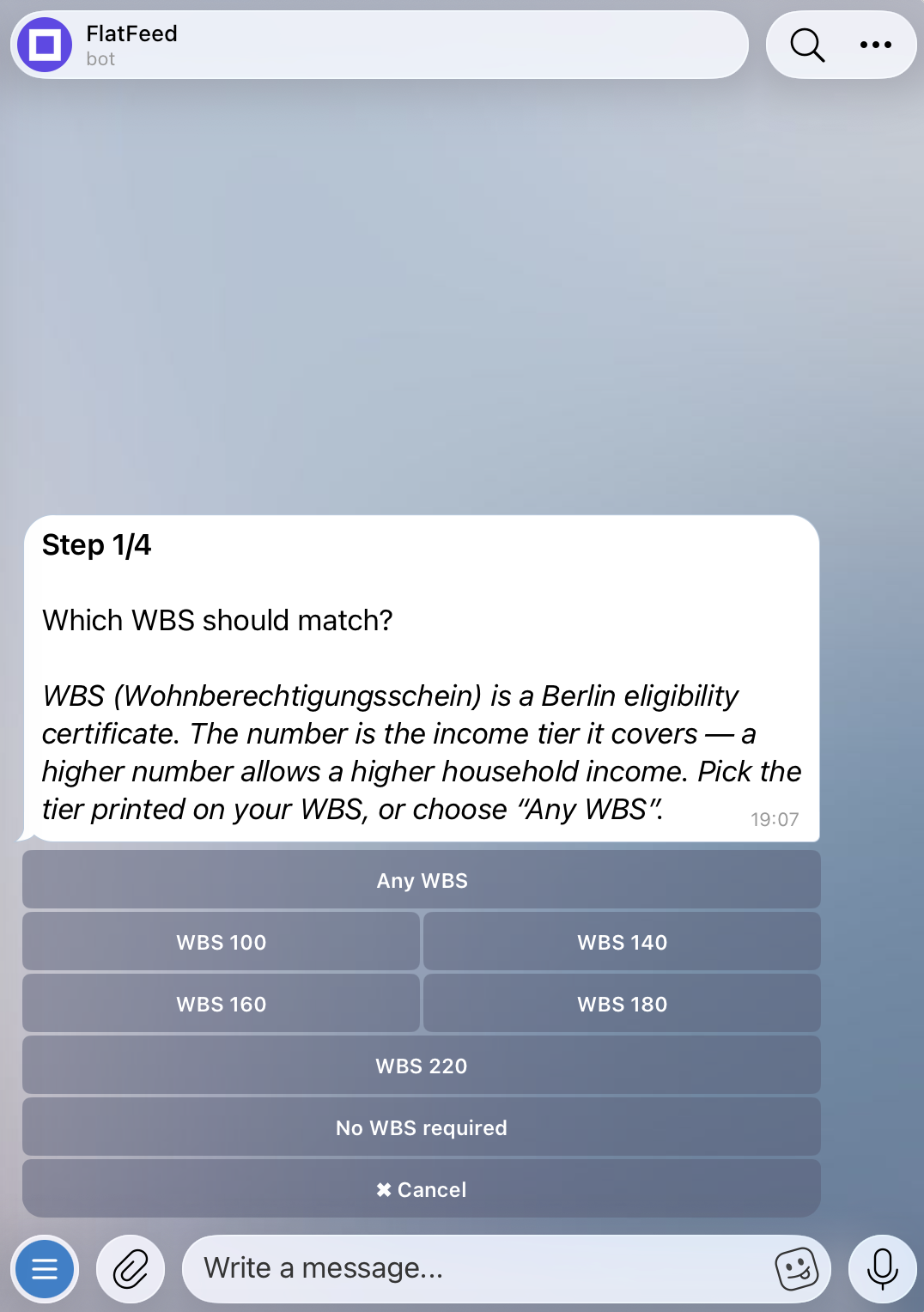
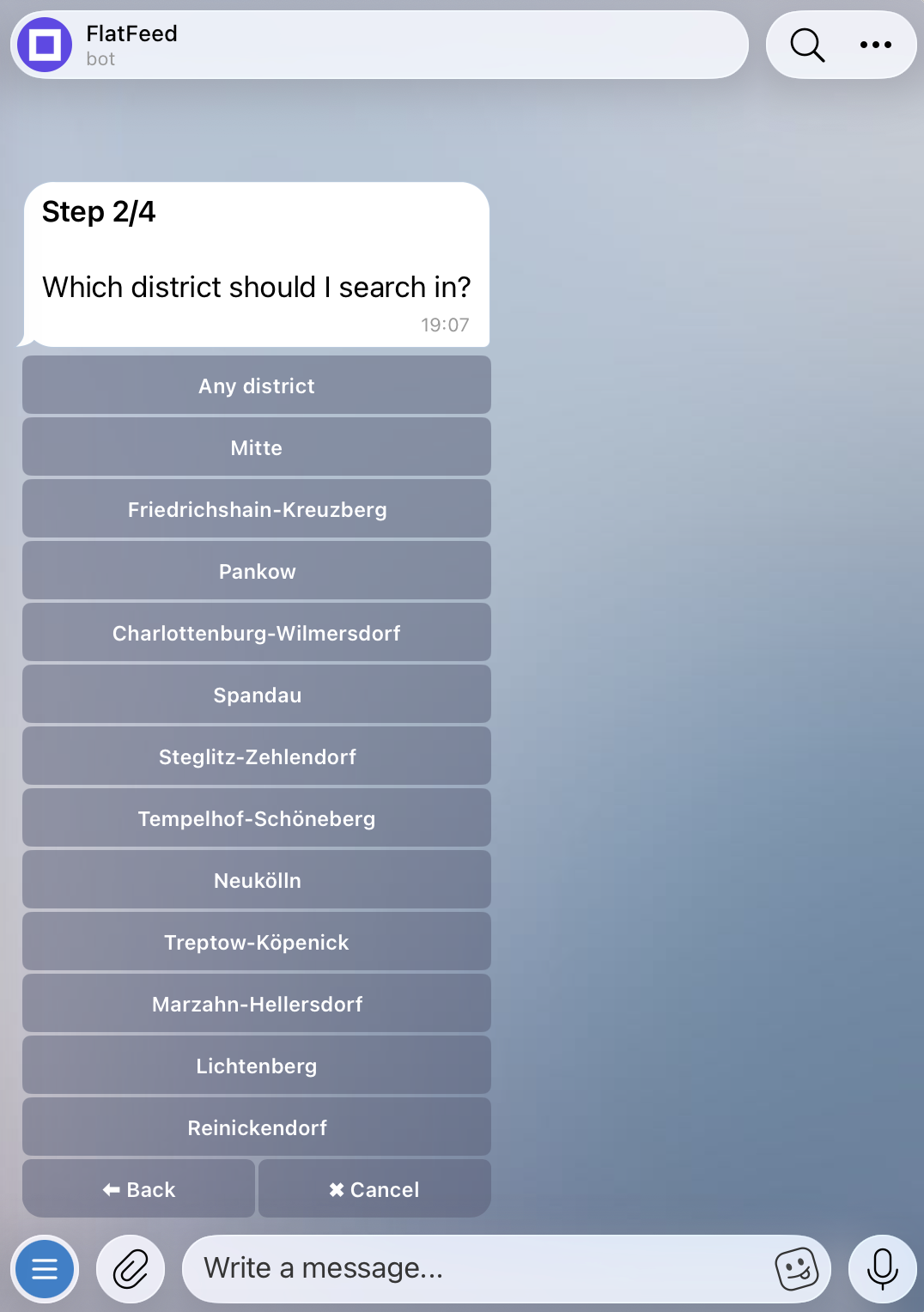
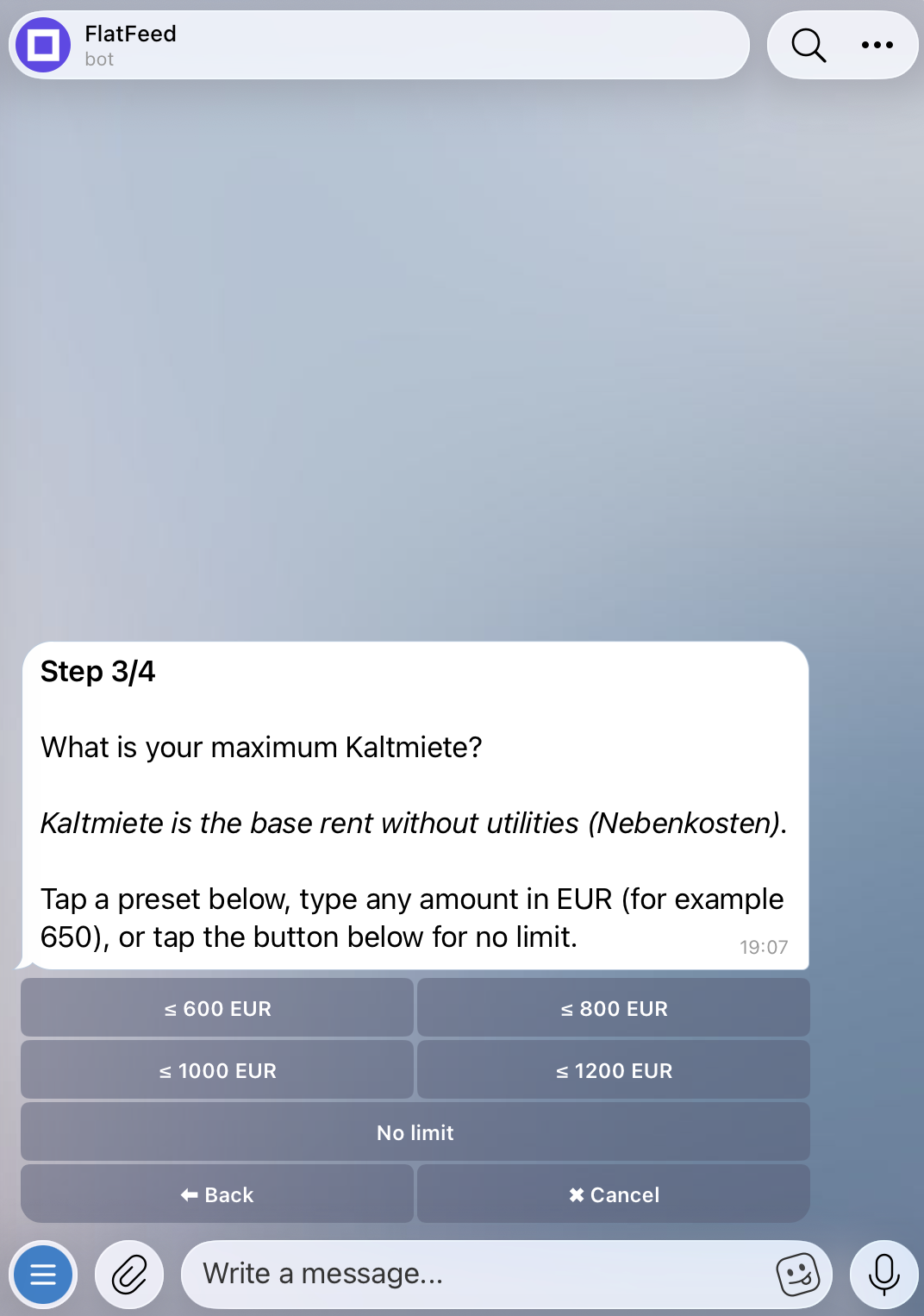
    Save one filter

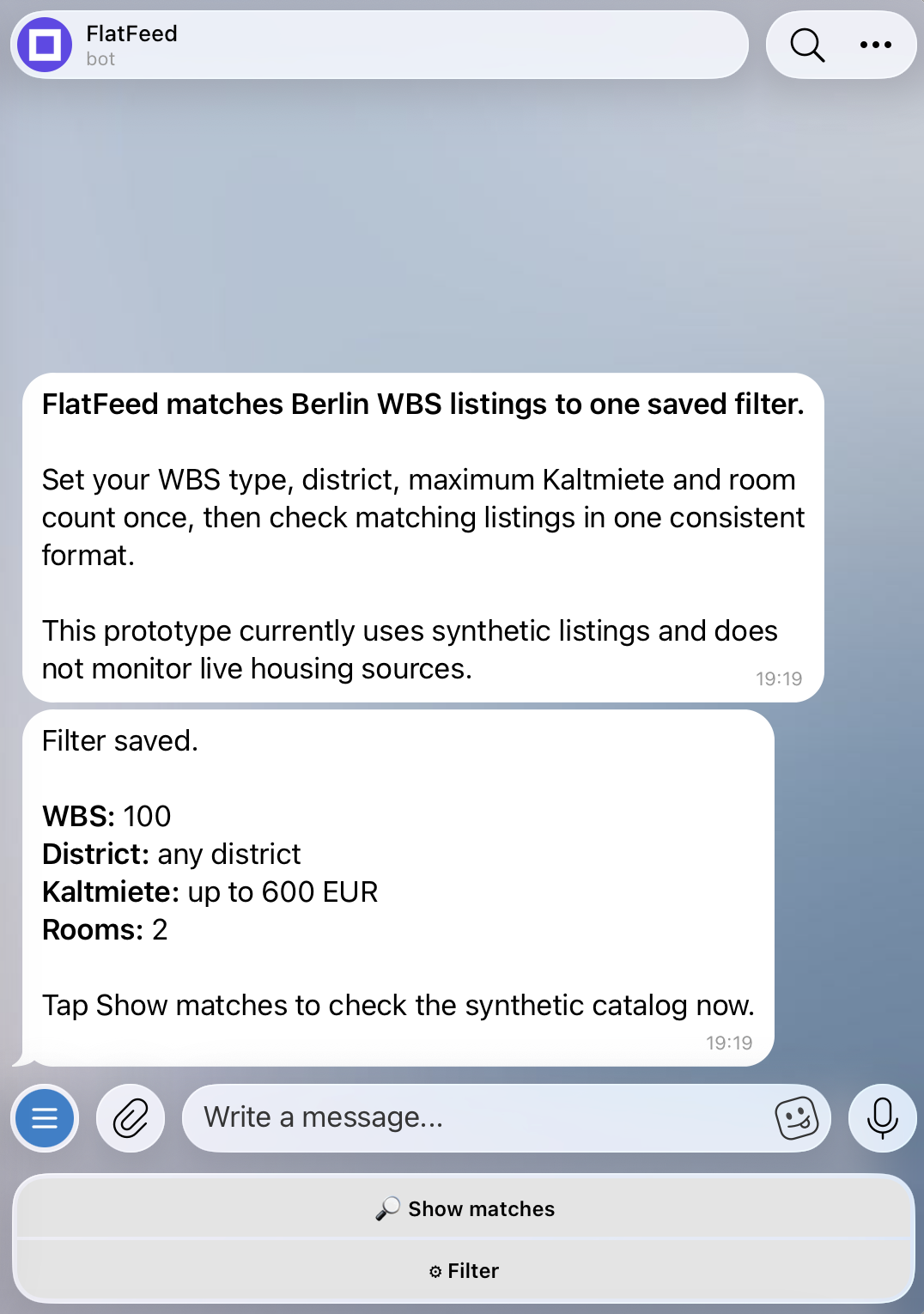
    Set WBS type, district, maximum Base rent, excluding operating and heating costs. and rooms once.

  2. 02

    Normalize each source into one listing format

    Each permitted source would map into the same listing format. Structured feeds can supply fields directly; text-based or incomplete sources require extraction. This prototype implements the text-based path.

  3. 03

    Match with rules

    Code compares each listing with the saved criteria. If a required value is missing, the listing does not match.

  4. 04

    Return matches in Telegram

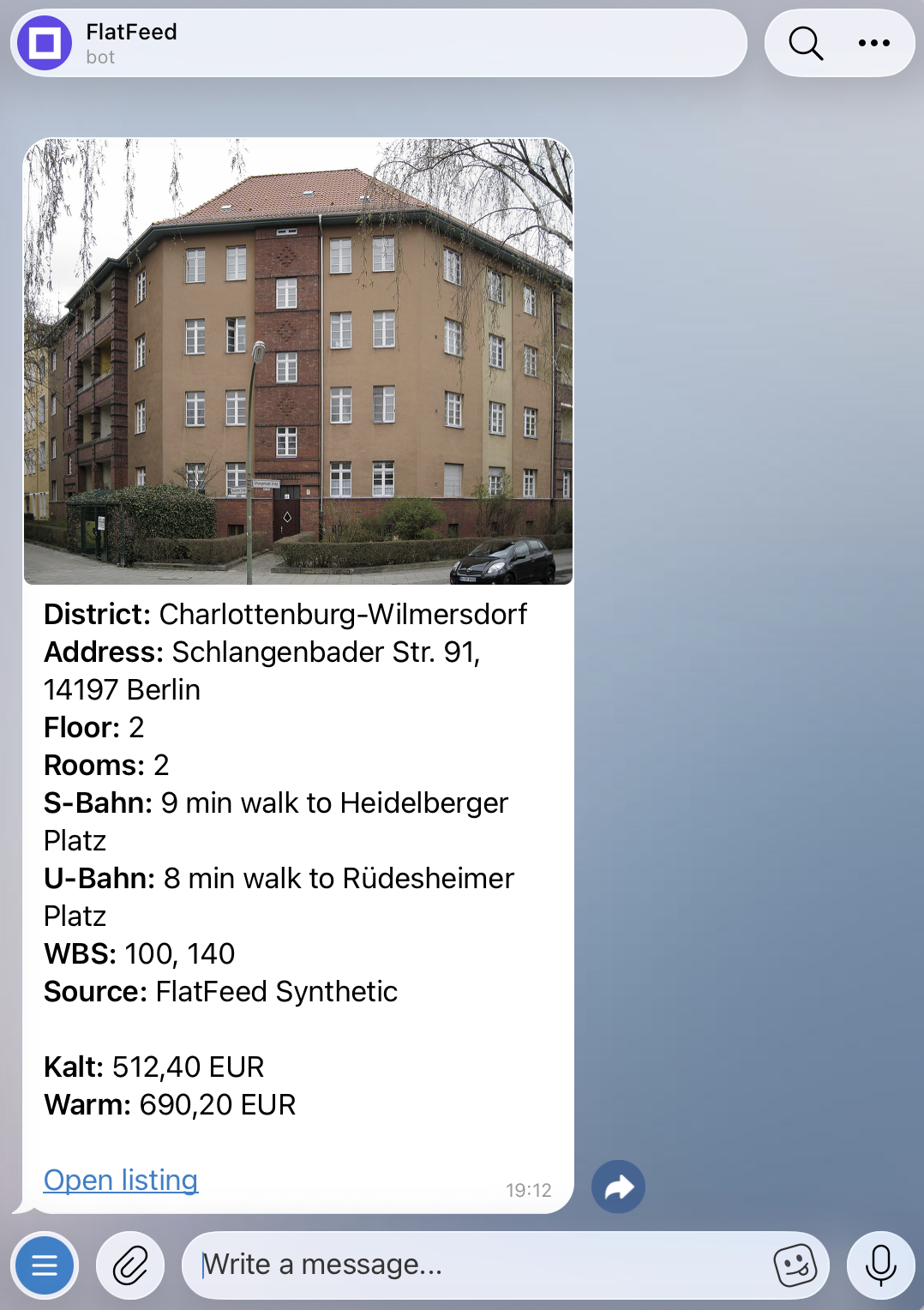
    Users can request matches when they want. FlatFeed returns each match in a Telegram card. After a user saves a filter, FlatFeed automatically sends each new match in Telegram and records each successful send to prevent duplicates.

See the current prototype limits

The prototype currently uses generated listing text rather than live provider data. It implements one possible ingestion path: deterministic extraction into a common listing format with an admin-only AI quality check.

How listings reach FlatFeed in production depends on the access method, data format and information each provider supplies. Complete structured feeds can be added directly; text-based or incomplete sources may still need extraction and review.

Automatic delivery and the runtime AI check are built but disabled in this prototype. The AI-check results come from an offline evaluation using synthetic listing data, not listing data from real providers.

03Decisions

Three decisions kept the prototype focused and testable.

A

Evaluate AI as a conditional quality check

For this self-directed portfolio project, I deliberately tested one plausible text-based ingestion path to demonstrate how I scope, evaluate and constrain AI. The model checks parser evidence but never changes listings or decides matches. If a provider supplies complete, reliable structured fields, its adapter should map them directly; the parser and AI check are used only where extraction is actually needed.

B

Use synthetic data to test mechanics

I chose generated listings to test filter setup, normalization, matching and Telegram delivery without using provider data until source access and reuse terms are clear. This tests product mechanics, but not source coverage, listing freshness or renter value; those require permitted live sources and a real-user pilot.

C

Do not match listings when required details are missing

If rent or room count required by a filter is unknown, the listing does not match. This reduces unsupported matches but may hide a suitable apartment, so the trade-off still needs real-world validation.

04AI Evaluation

For text-based sources, correct matching starts with correct extraction.

This evaluation covers the prototype’s text-based ingestion path. AI independently checks the fields extracted by the parser and flags differences for admin review; rules still decide every match. A provider feed with complete, reliable structured fields could bypass this path.

How the check catches a wrong value.

Illustrative planted-error example.

Listing text

Charlottenburg-Wilmersdorf · 2 Zimmer · 512,40 € · WBS 100–140.

Parser output

WBS 140 Charlottenburg-Wilmersdorf €512.40 2

AI evidence

WBS 100–140 Charlottenburg-Wilmersdorf €512.40 2

Mismatch detected. The parser missed WBS 100 and could hide a suitable listing. Admin review required. AI flags the difference and stops there. A configured admin compares the original listing and marks the finding as parser error, parser correct or unsure. Nothing changes on the model's word alone.

But how well can the check flag parser errors?

Before testing any model setups, I defined the metric targets. I then compared model setups on separate development data. GPT-5.6-Terra with high reasoning met those targets, so I froze the setup before running it once on the locked 600-listing evaluation. FlatFeed already includes an admin-only AI check that asks a model for source evidence and compares it with parser output. To test one model configuration for that check, I ran it once on 600 synthetic listing pairs: 300 clean and 300 with one planted parser error. For each field, the model returned an exact source quote or no value, and code checked it against the parser output. There were no retries or tuning after the run.

Errors detected
100.0% Found all 300 planted errors (300/300)

Prototype target: at least 98% (294/300). Target met.

Unnecessary review flags
0.0% Flagged none of the 300 clean listings (0/300)

Prototype target: at most 1% (3/300). Target met.

Correct field identified
100.0% Located the affected field in all 300 error cases (300/300)

Prototype target: at least 98% (294/300). Target met.

Usable results
99.8% Returned a usable result for 599 of 600 checks

Prototype target: at least 99.5% (597/600). Target met.

See results by field

The checker met its target for every listing field.

An overall score can hide a weak spot. This breakdown shows how the check performed on each listing field.

Listing data Used in Errors found Target Result
WBS Matching + Telegram card 75/75 · 100.0% At least 74/75 Target met
District Matching + Telegram card 30/30 · 100.0% 30/30 Target met
Kaltmiete Matching + Telegram card 60/60 · 100.0% At least 59/60 Target met
Rooms Matching + Telegram card 50/50 · 100.0% At least 49/50 Target met
Address / postal code Telegram card 40/40 · 100.0% At least 39/40 Target met
Floor Telegram card 25/25 · 100.0% 25/25 Target met
Warmmiete Telegram card 20/20 · 100.0% 20/20 Target met
See cost estimate and evidence

What could AI checks cost at Berlin scale?

Berlin reported 12,398 apartment re-lettings by six state-owned housing companies in 2024, excluding Berlinovo. Because no public source gives a combined count of unique listings, I used 15,000 checks per year as a rounded planning scenario. View the Berlin source.

Based on the measured run

About $35/year $2.94/month · 15,000 × $0.00235 per check

The final 600-check run cost $1.412906.

Planning case · 25% buffer

About $45/year $3.68/month · 15,000 × $0.00294 per check

Adds a simple buffer for variation in listing length and model output.

This estimate covers AI API calls only. It assumes one check per unique listing for each prompt version and uses prices recorded on 30 July 2026. It excludes source access, hosting, monitoring, duplicate listings, price changes, differences in real-listing length and human review. The 12,398 re-lettings show the possible scale, not the number of ads a live system would process.

05Next

What should FlatFeed test with permitted sources?

A

Source access and format

Can FlatFeed secure a permitted data channel from each relevant provider and confirm what format the data comes in?

B

Fast delivery

How quickly do new listings reach FlatFeed after providers publish them?

C

User value

Are alerted listings still available and worth pursuing for users?

D

Conditional review loop

If a source requires text extraction, can admin review help fix parser errors and improve the AI check when an alert is wrong?

A working apartment-search workflow, with rules making the match.

I built and tested the saved-filter Telegram flow and evaluated one plausible way to process text-based listings with bounded AI QA. Matching remains rule-based; how listings enter FlatFeed in production should depend on the access terms, formats and data quality providers actually offer.